
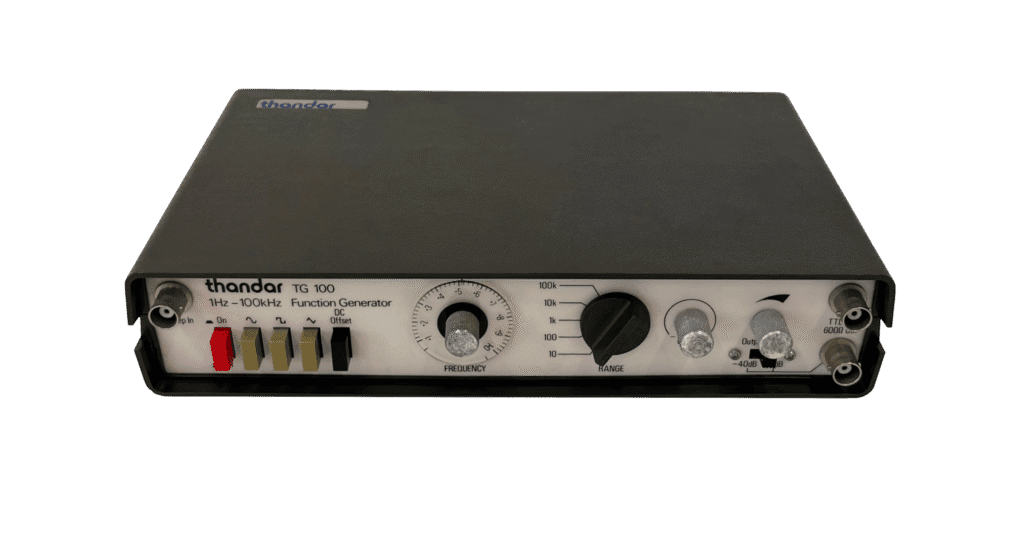
This compact signal generator produced continuous waveforms—sine, square, triangle, or DC—used to test and calibrate electronic circuits. With a frequency range up to 100 kHz, it was ideal for audio and low-frequency applications. The TG100 offered variable voltage and output shapes, allowing users to simulate different signal conditions. Common in repair benches, classrooms, and hobbyist workshops, it helped diagnose faults or evaluate circuit behaviour without needing a live input source.
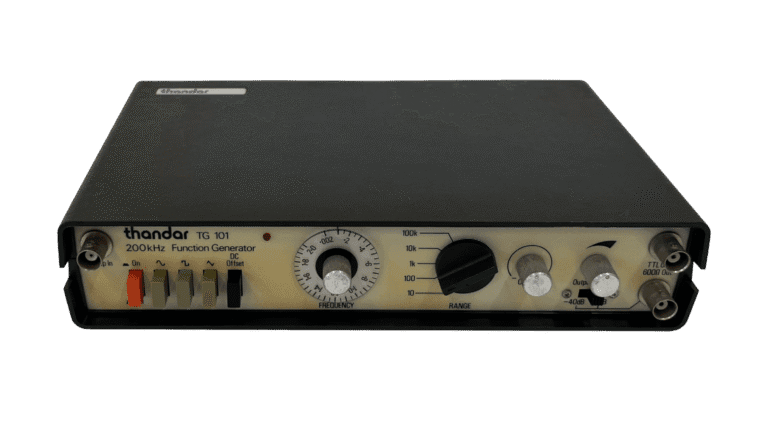
An upgraded version of the TG100, the TG101 doubled the available signal frequency range to 200 kHz. It maintained the same waveform versatility—sine, square, triangle, and DC—while improving performance for higher-speed signal testing. Its extended range made it suitable for a broader range of audio, analog, and control applications. Like others in the TG series, it helped users simulate and evaluate circuit behaviour under different signal conditions.
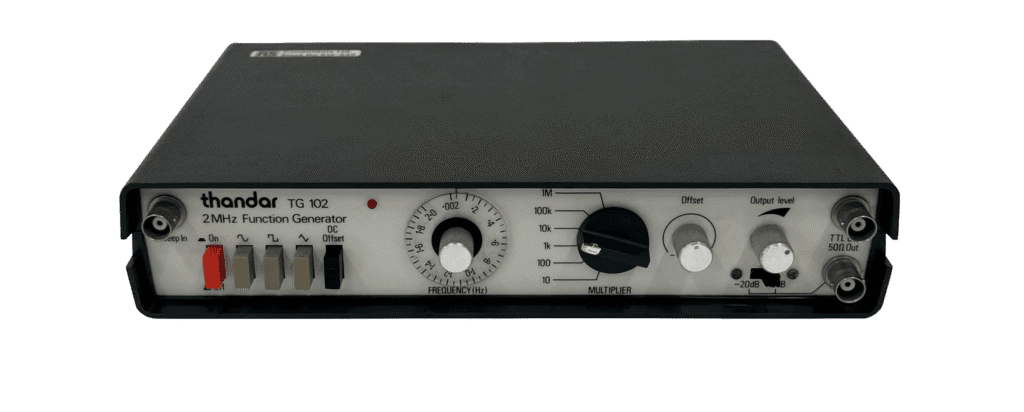
Designed for more demanding tasks, the TG102 could generate waveforms up to 2 MHz—twenty times the range of the entry-level TG100. It offered precise, stable signals for testing radio-frequency and digital circuitry. Additional features included external sweep capability and a wide voltage range, useful for pushing circuits to their limits. Positioned at a higher price point than other models in the TG series, it was aimed at users needing a more advanced tool for both everyday testing and complex electronic development.
Unlike the TG100–102 series, which produced continuous waveforms, the TG105 specialised in generating controlled pulses. It allowed users to set the frequency, width, and timing of each pulse independently—useful for simulating switching signals in digital circuits. Operating from 5 Hz to 5 MHz, the TG105 could mimic anything from slow relay triggers to high-speed data bursts. Its precise controls and multiple output options made it a versatile choice for testing logic circuits, timers, and microprocessors.
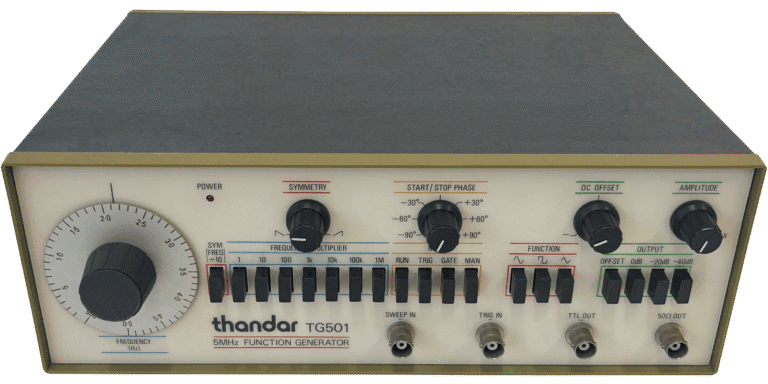
The TG501 produced precise test signals for checking and calibrating electronic circuits. It could generate continuous waveforms from cycles lasting minutes to millions per second, with exceptionally low distortion. Used in laboratories, workshops and classrooms, it allowed engineers and students to observe how circuits responded to changing inputs. The model’s robust design and clear controls made it a practical tool for work with emerging digital systems. This example was built at Thandar’s new Huntingdon premises, reflecting the company’s late-1980s expansion beyond its former Sinclair site in nearby St Ives.
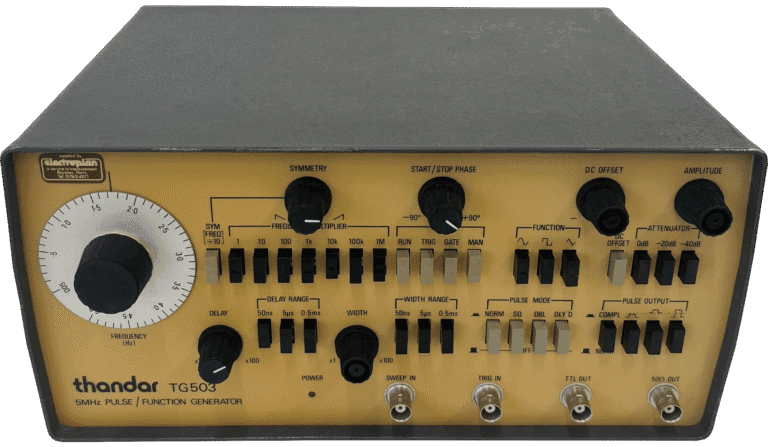
The TG503 was the most advanced and costly model in Thandar’s TG500 series. It combined a function generator with a pulse unit capable of producing normal, double, or delayed pulses—tools essential for testing timing-sensitive circuits. Covering frequencies from slow cycles to five million per second, it supported both analogue and digital work, allowing engineers to simulate switching signals. This example was modified for 120 V operation, enabling use in regions with different mains voltages, and was built at Thandar’s St Ives premises before the company moved to larger facilities in Huntingdon in 1989.